
Mobile ECG Management: 7 Security Questions

Now that ECG management technology has successfully bridged the gap between the testing clinic and the location of the interpreting Cardiologist, we are increasingly getting inquiries about applying that technology to the field of mobile ECG testing. In particular, we are contacted by organizations that are interested in moving, for the first time, to electronic management of ECG tests that are acquired outside the environment of a hospital or clinic.

Information is readily available on portable ECG devices that are designed for mobile testing. Much of this information focuses on the portability of the ECG device, on connectivity options and on the early treatment benefits that can be achieved by mobile ECG testing. However, the questions that we are asked first and most often are the ones that relate to security and confidentiality in mobile ECG management.

Because healthcare providers have less control over a mobile testing environment, protection of ECG data is more challenging. Therefore, any provider who is shopping for a mobile ECG management solution will be very interested in the answers to these seven questions: How do I protect my portable ECG device from being accessed by unauthorized users?

  1. How is the ECG data on my ECG device protected after I acquire it?
  2. What are my options for transmitting the ECG data after it is acquired?
  3. How do you keep the ECG data secure while I am transmitting it for interpretation?
  4. How will I know if the data has been successfully transmitted from my ECG device?
  5. How will I know if the data has been successfully received?
  6. Can I purge the data from my ECG device after transmission is completed?
ECG Management: Making the Connection

It is common for an ECG testing organization to confront the issue of incompatibility between its preferred ECG device and its preferred ECG data management software:

  1. The preferred ECG management system does not support the preferred ECG device.
  2. The manufacturer of the preferred device does not offer an ECG data management system.
  3. The organization is using ECG devices from a variety of manufacturers and there is no data management system that supports all of them.

These issues are often resolved turning to a Format Translator. The Translator converts the ECG data from the format of the ECG device to the format of the ECG data management system. This solution allows flexibility in selecting the best devices and management systems for an organization. However, there are limitations to this solution:

  1. The Translator translates a single language to a single language. Therefore, an organization using devices from multiple manufacturers may have to purchase a unique type of Translator for each brand of device.
  2. The Translator is unidirectional. The Translator accepts commands from the ECG device but cannot issue its own commands back to the ECG device. Therefore, the work flow for acquiring ECG tracings is completely governed by the software of the ECG device.

TeleMED’s Bi-directional Multi-device Interface (BMI) is a single-application interface that provides bi-directional compatibility between TeleMED’s ECG data management system and ECG devices from a wide variety of manufacturers. Like a Translator, the BMI allows an organization to select an ECG device without regard to compatibility issues. However, the BMI offers additional value:

  1. An organization can purchase one BMI and utilize it for multiple brands of ECG devices.
  2. An organization can regularly change the brand of device it uses without incurring a cost for a new interface each time.
  3. The BMI can be leveraged to customize and standardize the logic and work flow for acquiring ECG tracings without regard to the brand of ECG device being used.

QUALITYflo: Automated ECG Review

Not long ago, I visited a large organization with a busy ECG testing service. During that visit, I observed the process used by a manager to review ECG tracing quality, using the organization’s ECG management system. Here is the process:

  1. Log into the data management application, manually select a sample of tests to review and compile them into a Work List.
  2. Set up a spreadsheet in Excel that includes fields for identifying each test being reviewed and the staff member that acquires the ECG tracing.
  3. Toggle back to the Work List and click on the first test to open the tracing for review.
  4. Review the test for quality purposes.
  5. Toggle to Excel and enter the following data:
  6. Test identification
  7. Technician/Nurse identification
  8. Comments on tracing quality
  9. Toggle back to the Work List to select the next tracing

You can see that almost all of these steps are time-consuming, administrative tasks. Many of them involve moving from work list to tracing to spreadsheet and back to work list. As a result, the majority of the time is spent on tedious tasks when the review itself is the most important part of the process.

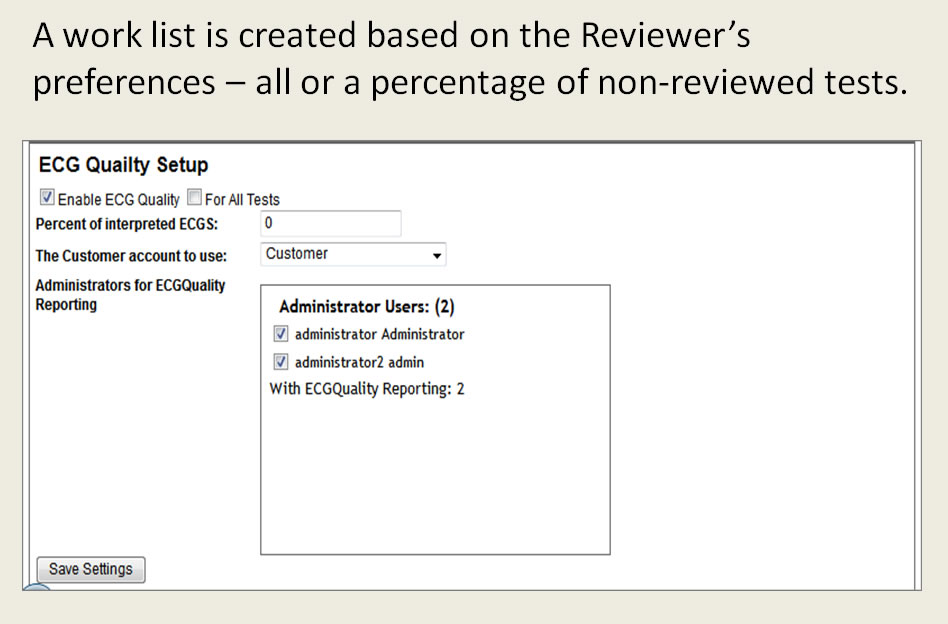
TeleMED's QUALITYflo technology reduces the duration of a review session by up to 80%Here is how TeleMED’s QUALITYflo technology reduces the duration of an ECG review session by up to 80%:

  1. The Work List is generated automatically, according to parameters that the user selects by ticking check boxes or according to the parameters used to generate a previous Work List.
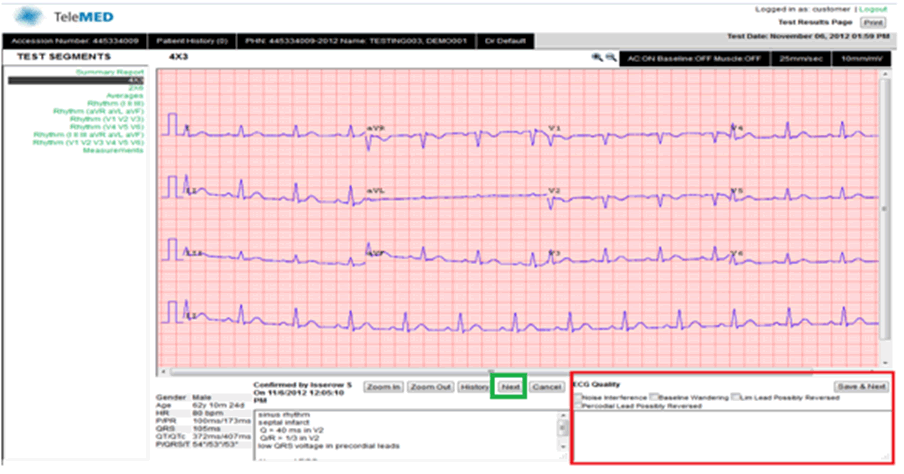
  2. Comments are entered using point-and-click technology.
  3. Review and the documentation are performed inside one application.
  4. QUALITYflo automatically sets up a spreadsheet and automatically populates the spreadsheet, including the reviewer’s comments.
  5. No need to toggle back and forth between two applications.
  6. No need to toggle back to the Work List to open a tracing. When a tracing file is closed, the next one opens automatically.

All ECG data management systems focus on streamlining the process of acquiring and interpreting ECG tracings. However, exceptional ECG management systems use the same principles to deliver efficient retrospective review of the quality of those tracings.

Exceptional ECG Management Reports

Busy ECG testing organizations benefit greatly if their ECG data management systems include exception reporting and exception triggers. Exception Reports automatically scrub voluminous management reports of “normal” data. As a result, the time required to identify operational issues is reduced and the risk of overlooking those issues entirely is eliminated.

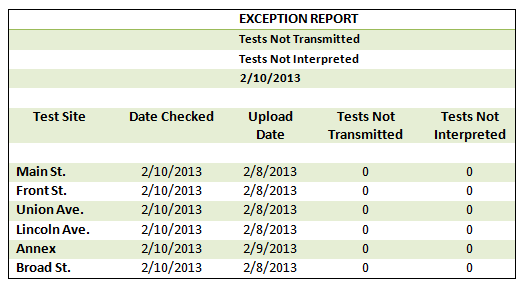
Here are two Exception Reports that will deliver actionable information on the timeliness of your ECG serviceHere are two Exception Reports that will deliver actionable information on the timeliness of your ECG service:

Interpretation Exception Report

Your organization has mandated that your Interpreting Physicians must interpret an ECG test within 18 hours but you don’t know how consistently your organization is meeting that standard. A weekly or daily Exception Report will provide the answers. Your management system will measure the time between the date/time of the test acquisition and test interpretation, screen out the “normal” data and generate an Exception Report that highlights those incidents that are outside the norm.

Distribution Exception Report

Your organization mandates that an ECG interpretation must be printed, faxed or electronically distributed to the Ordering Physician within 24 hours of the test being performed. What you need is hard evidence of how you perform against that standard. A standard Activity Report be able to show that lag time on a per-test basis. An Exception Report is better because the information has been reviewed for you and the report will only show those instances where the standard has not been met.

Enhance Your Exception Reports with Alerts

Exception Reports can be valuable in identifying and focusing your analysis on key operational issues. However, the most robust ECG management systems go beyond Exception Reports by triggering an immediate e-mail or text alert when an exception occurs.

For instance, your management reporting would enable corrective action in real-time if it included an alert that notifies you immediately if a specific test is not interpreted within 18 hours. Then you could take corrective action by contacting the responsible Physician or re-assigning the interpretation of that test to a Physician that is available.

Measure the health of your ECG business

Measure the health of your business with ECG Management Reports

ECG data management technology can improve the health of your patients by collecting and centralizing information and by making it available in real-time. Problems are identified and treatment plans are implemented without delay.

However, a system with sophisticated management reporting can also yield valuable information for measuring and improving the health of your business.

Content of Management Reports

Obviously, the information that your reports can contain is limited by the information that can be entered into the system. Therefore, when evaluating an ECG management system, review the information that it captures. For instance, if you want to compare the activity level at each of your testing sites, the system must capture the unique location where each test is taken.

Over 50 types of information

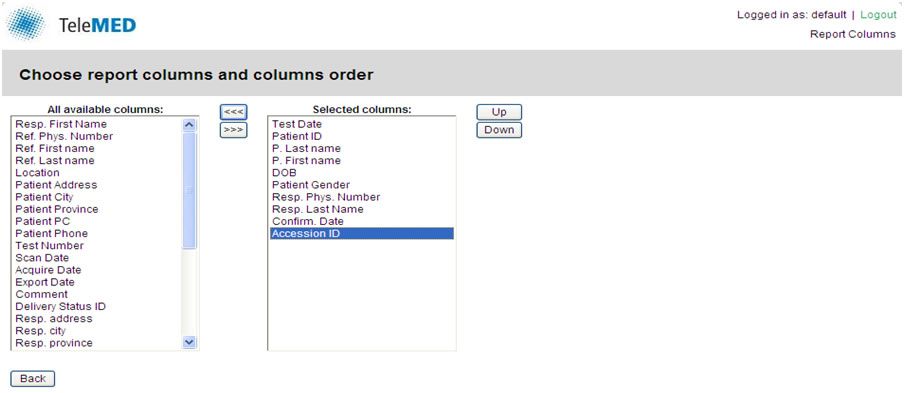
TeleMED’s REPORTflo module allows user to select from over 50 types of information and arrange report in a preferred order. CLICK TO ENLARGE

Flexibility in Report Generation

Most ECG management solutions offer standardized activity reports such as:

  • Test count
  • Interpretation count
  • Interpretations outstanding

These questions can be used to identify systems with advanced capabilities:

  • Does your system’s retrieval query engine allow user defined search variables?
  • Can activity reports be generated by Clinician, by testing site, by Cardiologist?
  • Does your software support searches employing a range of dates?
  • Can query response lists be filtered to show only results that the user is authorized to see?
  • Can I build a Quick Link to the reports that I use the most?
  • Can I customize the format by eliminating/adding types of information displayed and by dictating the order in which that information is displayed?
ECG Management Reports can be easily exported

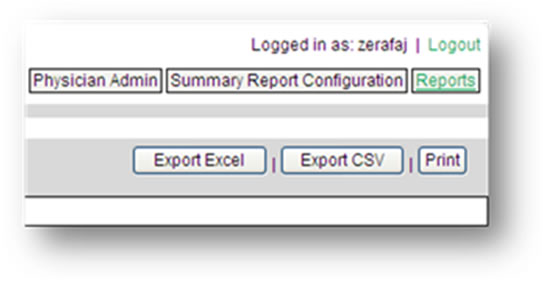
Print and Export TeleMED ECG Management Reports. CLICK TO ENLARGE

Sharing and Analyzing Information

The value of the information in your Reports can be enhanced if it can be easily shared and easily reviewed. Most ECG management systems will support printing or e-mailing of Reports. It is preferable if the Report can be exported to other formats (e.g. – Excel) to facilitate more intense analysis.

In future blogs, we will look at ways to use specific Management Reports, including Exception Reports.

What’s Next in ECG Management Technology?

There is no question that the introduction of electronic ECG management brought vast improvements in productivity, profitability and clinical outcomes.

  • Processes were automated and streamlined.
  • Best practices were standardized.
  • Patients were given access to clinical experts regardless of their location.
  • The flow of patients increased and so did the flow of revenue.

ECG Quality StatsOnce users became accustomed to the benefits of electronic ECG management, the search began for other ways to wring inefficiency out of workflows. Before long users focused on the issue of connectivity, making demands such as

  • “I don’t want to enter patient demographics into my ECG management system if they already exists in my booking system.” and
  • “I want my patient’s ECG results to sit in the same place as her other test results.”

The response to these and similar demands was “We can make it happen”. As a result, ECG management systems now feature open system architecture so that they can be seamlessly connected to other information systems in the same enterprise.

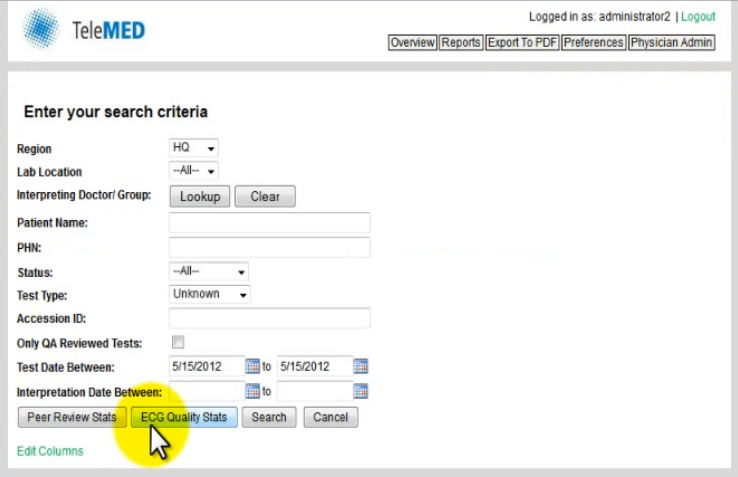
ECG Quality StatsAll of this leads to the inevitable question, “What’s Next?” At TeleMED we believe that the next place to look for productivity gains is in the workflows related to the management of ECG tracing quality and the management of interpretation quality.

All of our customers stress the need for constant monitoring of and improvement in ECG quality. All of them believe in and have quality management programs. However, in an environment that demands better and better service with fewer and fewer resources, all of them struggle with the time required to make these programs work. We have looked closely at the steps our customers take in conducting retrospective reviews. Based on our success in streamlining the process of acquiring test data, we are now using the same strategies to streamline the process of reviewing that data. We have even identified enhancements that we will add to our application to detect certain quality-related problems in real-time.

More to come in future posts.

Prioritizing Quality Management

TeleMED Prioritizes Quality Management with New Software Features

(Toronto) TeleMED Diagnostic Management Inc. (TeleMED) is proud to announce the ongoing development of QUALITYflo, a web-based Quality Management and Peer Review suite of tools designed specifically to address the need for greater efficiency and efficacy in ECG quality management.

QUALITYflo offers functionality for detecting technical inadequacy in all three stages of ECG processing – the pre-analytic, the analytic and the post-analytic stages. While QUALITYflo provides tools for identifying inadequate test quality after the fact, users will also be pleased by features that are available for detecting inadequacies in real-time.

Stephen Chernoff, Director of Marketing & Sales, commented, “The launch of QUALITYflo will be the culmination of a truly collaborative process between TeleMED and the healthcare providers with whom we partner. The transparency in our relationship with our partners made it possible for us to identify the role that our technology could play in supporting their quality assurance programs. Most of the features incorporated into QUALITYflo originated with these providers and we are delighted with the level of enthusiasm with which they respond when we show them how we are turning their ideas into reality. Their willingness to invest their time in testing and providing feedback will mean that they will have a product that will be effective in improving patient care, increasing productivity and reducing costs.”

Download the PRESS RELEASE

For more information, please contact Stephen Chernoff at 416-665-8556.

Partnering With Gamma-Dynacare

TeleMED Partners With GDML for Holter Management Services

(Toronto) Gamma-Dynacare Medical Laboratories (Gamma-Dynacare) has once again selected Telemed Diagnostic Management Inc. (TeleMED) to provide its electronic solution for Holter data management.

Because of this collaboration, a Gamma-Dynacare patient has the opportunity to book an appointment at a local Patient Service Centre, be tested and receive a diagnosis from a physician who is a cardiac specialist, all within a one week period. For many, this represents an attractive alternative to waiting for weeks for an appointment and travelling to a hospital or cardiology clinic to be tested.

Asa Lebel, President of TeleMED stated, “We are pleased to continue our partnership to provide quality Holter monitoring services to Gamma-Dynacare’s patients. The integration of Gamma-Dynacare’s wide network of testing sites with TeleMED’s unique solution for managing Holter data ensures that a patient can have easy and quick access to the expertise of a cardiac specialist.”

Download the PRESS RELEASE

For more information, please contact Stephen Chernoff at 416-665-8556.

Renewing ECG Management Partnership

DynaLIFE Dx extends agreement for ECG data management solution

TeleMED Diagnostic Management Inc. (TeleMED), announced today that DynaLIFE Dx (DynaLIFE), a leading provider of quality diagnostic laboratory services in Alberta, will be continuing to use TeleMED’s ECG data management solution.

(Toronto) Since 2007, DynaLIFE has depended upon TeleMED’s user-friendly and efficient technology for the collection, sharing and storage of its vital ECG data throughout its network of Patient Service Centers. At the core of this partnership is a unique technology that automates and accelerates workflow in all of the pre-analytic, analytic and post-analytic stages of processing. Turnaround on test results was reduced from days to hours. As a result, during the past five years, ECG revenues have multiplied, associated costs have been reduced and profitability has risen dramatically.

Asa Lebel, President of TeleMED Diagnostics commented: “We are delighted that we will be continuing our collaboration with DynaLIFE. This renewal validates the value of TeleMED’s ECG data management technology and DynaLIFE’s ability to grow its business and serve the public by promoting the improvement in care that the technology enables it to offer to its patients. At a time when the standard and affordability of healthcare are in the spotlight, it is increasingly important for TeleMED to contribute trustworthy and cost-effective solutions for managing medical diagnostic data.”

Download the PRESS RELEASE

For more information, please contact Stephen Chernoff at 416-665-8556

TeleMED’s White Paper

For years, TeleMED has been Canada’s pioneer in electronic vital-sign management.  Its suite of solutions has become a solid, sensible option for healthcare providers who require innovative ways of managing documents and content.

That’s why more than 3,000 users use our technology, every day, to process vital sign tests.  See how TeleMED continues to build on its proven record to solving problems resulting from time consuming, costly and error-plagued manual tasks.

Download our white paper: